Scaffold-Anchored Recruitment and Binning
Putting the pieces back together again.
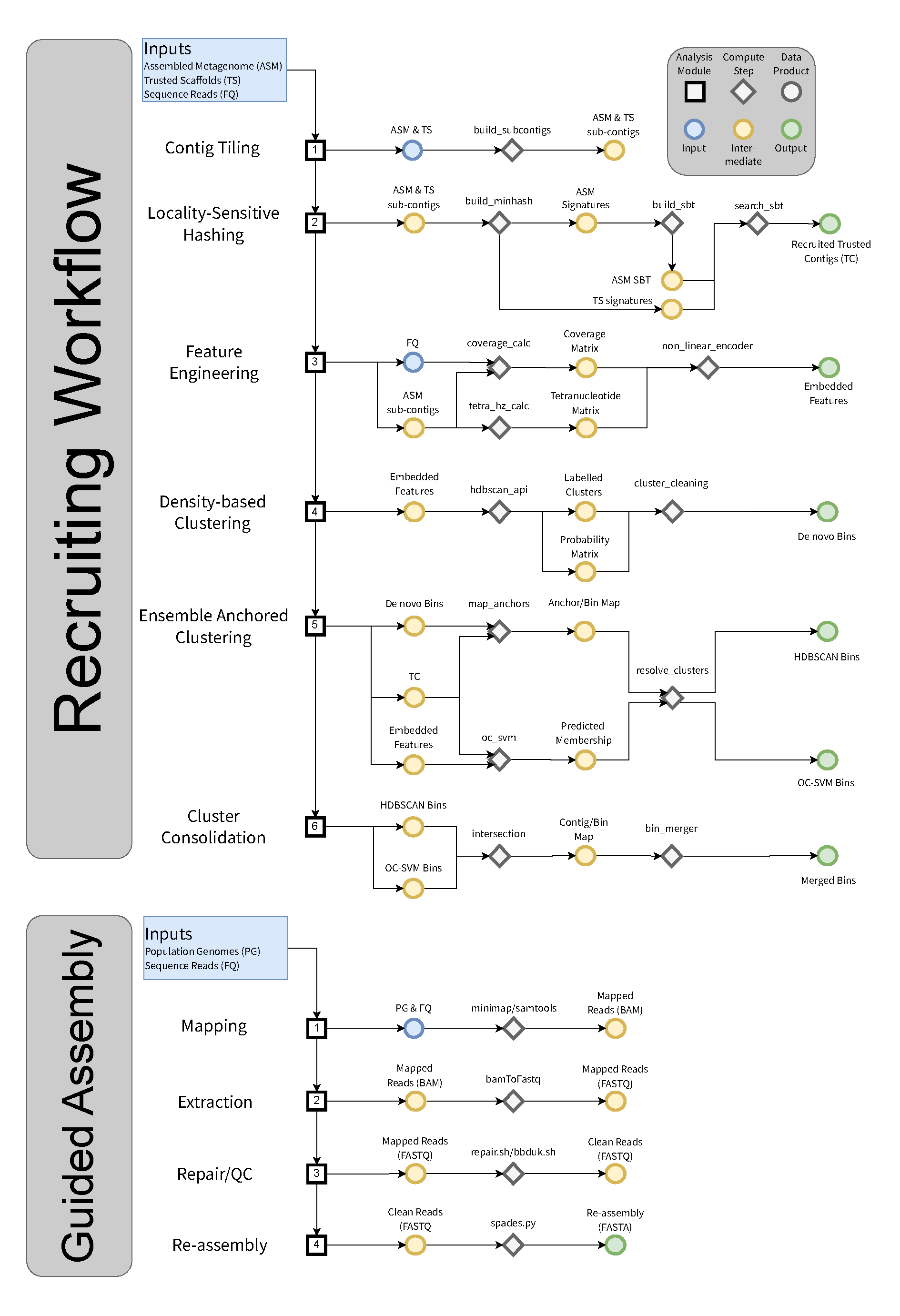
A metagenome represents genomic information extracted from environmental, enrichment, or host samples, sequenced and assembled into a multi-organismal dataset that can be analyzed as a collective metabolic network or subdivided into genomic bins of closely related genotypes. These bins, or metagenome-assembled genomes (MAGs), are constructed through comparisons to reference genomes and intrinsic nucleotide signatures such as GC content or k-mer frequency. Though routinely used to link taxonomy and function, binning methods suffer from chimeric assembly artifacts, coverage bias, and contamination, and automated quality assessment remains unreliable, often requiring impractical manual curation at scale. A more direct approach generates single-cell amplified genomes (SAGs) via cell sorting, whole genome amplification, and sequencing, resolving genotypic diversity with confident taxonomic labels and higher-confidence taxonomy-function linkages than MAGs, though SAGs suffer from incomplete genome coverage (typically under 50%) and amplification bias. The scaffold-anchored recruitment and binning tool (SCARAB) is under development, applying data mining and machine learning to cognate SAGs and metagenomes to produce more complete population-level genome assemblies.
Availability: https://github.com/hallamlab