Anaerobic Digestion of Mixed Manure Waste
Charting microbial community dynamics during anaerobic digestion of mixed manure waste for improved RNG production.
Working Group: Engineered Living Materials
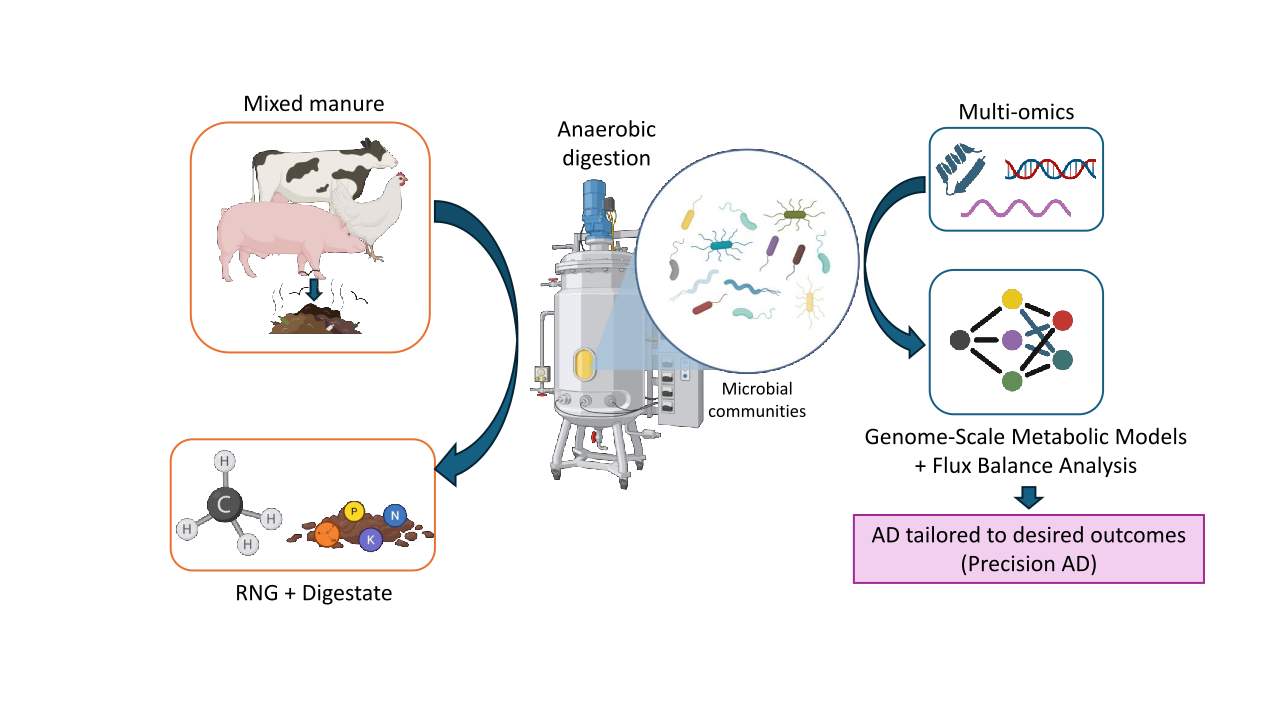
Livestock manure constitutes one of the largest organic waste streams globally, posing significant challenges to air, soil, and water quality. Anaerobic digestion (AD) is a microbially driven process enabling resource recovery from such waste by producing methane as renewable natural gas (RNG) alongside other value-added compounds, offering a circular economy solution to manure management. Energy yields, however, often fall short of theoretical values due to imbalanced substrate composition and incomplete understanding of microbial interactions. The Hallam Lab applies multi-omic approaches, spanning genomics, transcriptomics, proteomics, and metabolomics, to characterize microbial community structure and function across mixed-manure AD systems under varying conditions. Working with semi-continuous 4500 L and batch 400 L reactors, 16S rRNA, metagenomic, single-cell genomic, proteomic, and metabolomic data are integrated with physicochemical measurements to resolve trophic interactions driving RNG production, informing genome-scale metabolic models that guide optimized co-digestion and farm-to-grid RNG production.